
Marshall Park and Esther Short Park: Introducing Radically Inclusive Play in Vancouver
One spring day nearly five years ago, I visited Arbor Lodge Park in Portland to write a story about a new playground. It was the first time I had heard the term “radically inclusive” when referring to a park, and I was curious about what that would look like. I learned about G Cody QJ Goldberg and his mission to create spaces for his daughter, Harper, who used a walker and wanted to play at city parks like other children. He and his family created the nonprofit Harper’s Playground, completing their first inclusive playground in 2012.
My kids were in the first and second grade at the time we visited, and it was a significantly different park than any we had visited before. I remember how relaxing that day was for me and how fun it was for them; there were plenty of things to climb, places to explore, benches to rest on and, most importantly, new friends to meet.
Marshall Park’s CHAMPS Ribbon Cutting Ceremony
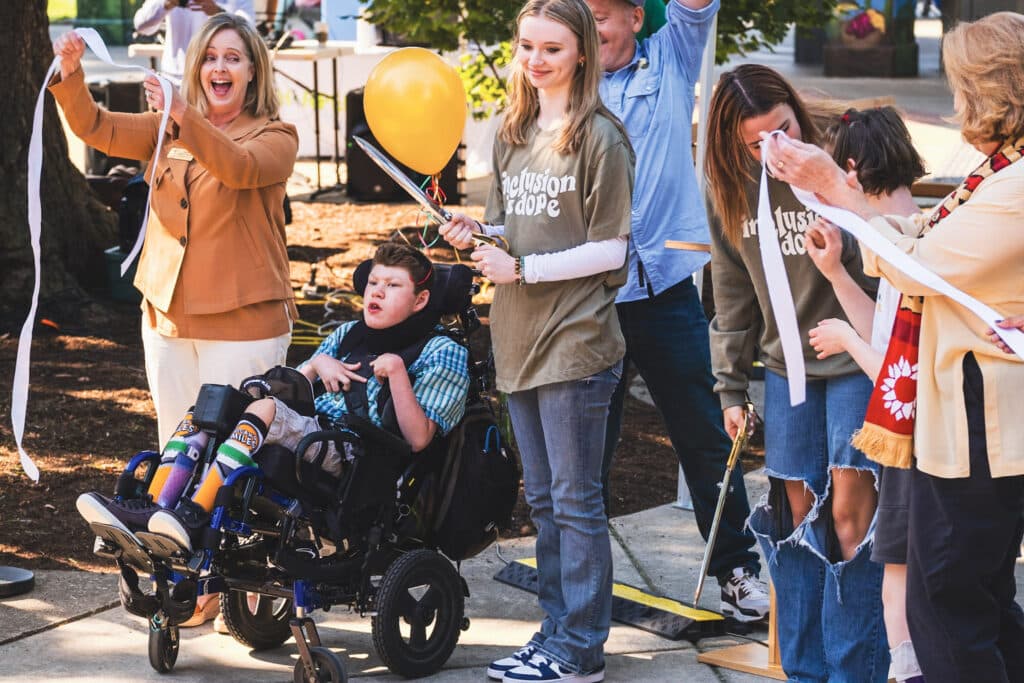
In September, I had the honor of meeting the actual Harper Goldberg as she cut a ribbon at the new Chelsea Anderson Memorial Play Station (CHAMPS) at Marshall Park in Vancouver. I was honestly a little star struck, realizing how many playgrounds are now accessible to disabled children across the United States, thanks to Harper and her family. Though the official ceremony began at 10 am, the party apparently started four hours earlier at 6 am, when skateboarders came early to enjoy the new ramps.
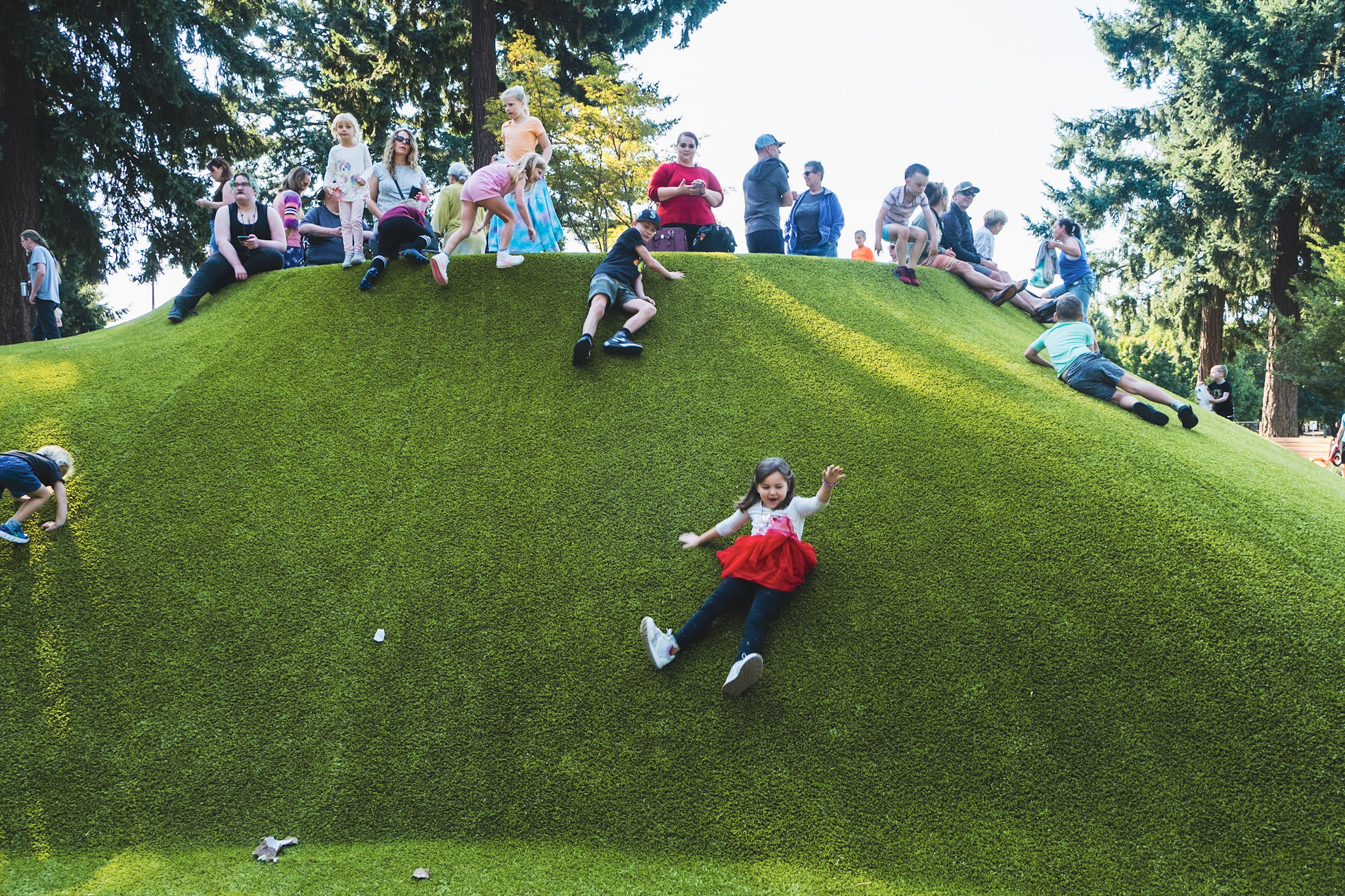
Kids playing on Marshall Park’s Harper’s Hill (a new play feature) throughout the speakers’ remarks enhanced their core message: Play brings a city together. Both Mayor Anne McEnery-Ogle and Tanna Engdahl, tribal elder of the Cowlitz Tribe pointed to them and the pure joy they brought to the event with Engdahl saying, “We see a place where children of all abilities can find laughter, friendship and the freedom to play in a place beyond the barriers of their bodies.”
Many educators attended the event at Marshall Park as well. Jaynee Haygood, former paraeducator with Vancouver School District and current chair of the Vancouver Parks and Recreation Advisory Commission shared a story of taking one of her former students who used a wheelchair to a city park. The child’s only option was to sit and watch as the other kids got to play. “To see this child who loved to laugh and interact with others now be limited and restrained was heartbreaking,” she recalled. “Play is such a critical component in positive child development from social-emotional learning, brain development, problem solving, communication skills and creativity.”
When the City of Vancouver partnered with Harper’s Playground, Goldberg helped them to understand that a playground is not only for children—ideally a playground should be accessible for everyone. The planning team quickly got on board, excited to implement his vision of a socially, emotionally and physically inviting space.
“[Cody and his team’s] ingenuity, insight and passion for inclusive parks helped to highlight the powerful way that inclusive play spaces can positively transform communities,” shared Haygood. “And now this park with allow disabled parents, grandparents, friends, relatives and caregivers to be able to play together, no longer limited by constraints.”
Mayor Mcerny-Ogle pointed out that while “We may not all use a playground in the same way . . . we can still play together without the barriers that keep us apart. The paved pathways make is easy to get around on foot or on wheels, the separation of different play areas invites everyone to explore and to find a way to play in their own way and the natural setting and engaging art pieces spark the creativity and appreciation for our environment.”
Preserving the Past
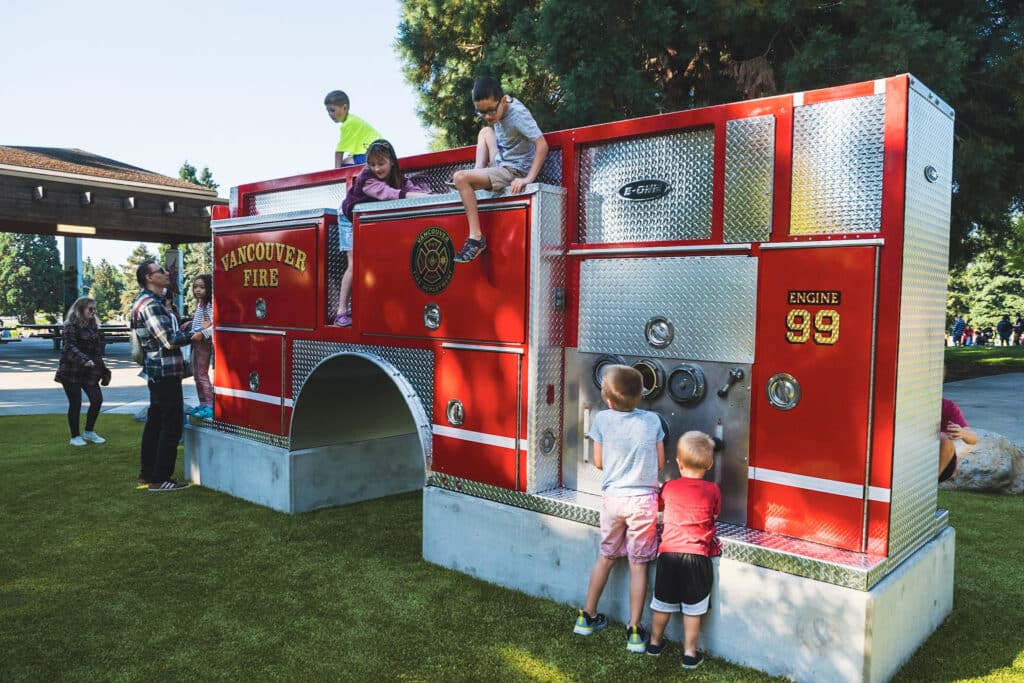
Those familiar with Marshall’s old playground will be happy to hear the fire truck theme was preserved. Vancouver firefighters built the original structure in 1999 to honor Fire Services Captain Kurt Anderson’s daughter, Chelsea Anderson, who had tragically drowned.
“When that former playground equipment needed to be replaced due to age, maintaining this site’s heritage was a priority for all of us,” shared the Mayor. “The playground you see today pays tribute to our community history and that includes the interactive art pieces . . . made from a real fire truck . . . and the upcycled fire hydrants that hold plaques with descriptions of the play areas and is written in both English and in Braille. The original Chelsea Anderson brick memorial has been preserved in place in this very special tribute area facing the playground. It’s been updated to recognize the generations of donors who have invested in this amazing playground for over two decades.”
Goldberg was excited to tell the crowd that, “The rings that you can climb on in the log play area are the rings that were salvaged from the original playground . . . There’s a net climber . . . that is made from decommissioned fire hose.”
In addition to traditional slides, monkey rings and climbing features, CHAMPS features a community spinner which makes it easier for kids of various abilities to join in on a carousel experience. There are also a sensory garden, a water wheel and whimsical sculptures of animals who look like they’re part of the play. A variety of swing types, including a disco swing that fits more than one person, makes swinging accessible for all.
Goldberg was especially proud to mention that Caleb’s Friendship Swing, one of the first wheelchair swings in the state of Washington, was named for a special classmate of Harper’s who passed away. If you get a chance to see that swing in use as I did, you’ll understand why I have a hard time putting into words the joy I felt for all the children there that day.
Building Spaces of Belonging
Attendants of the Marshall Park playground ribbon cutting event learned that it took six years to complete the entire project, from planning, designing and fundraising all the way through to completion.
In conjunction with CHAMPS, Harper’s Playground and the City of Vancouver also worked to redesign Esther Short Park’s playground, which was completed earlier in the summer. Though much smaller than Marshall Park, my kids and their friends were very happy we stopped there one afternoon to have a picnic. The teeter totter was their favorite equipment, while again, mine were the benches perfectly positioned under shady trees where my friend and I got a chance to catch up.
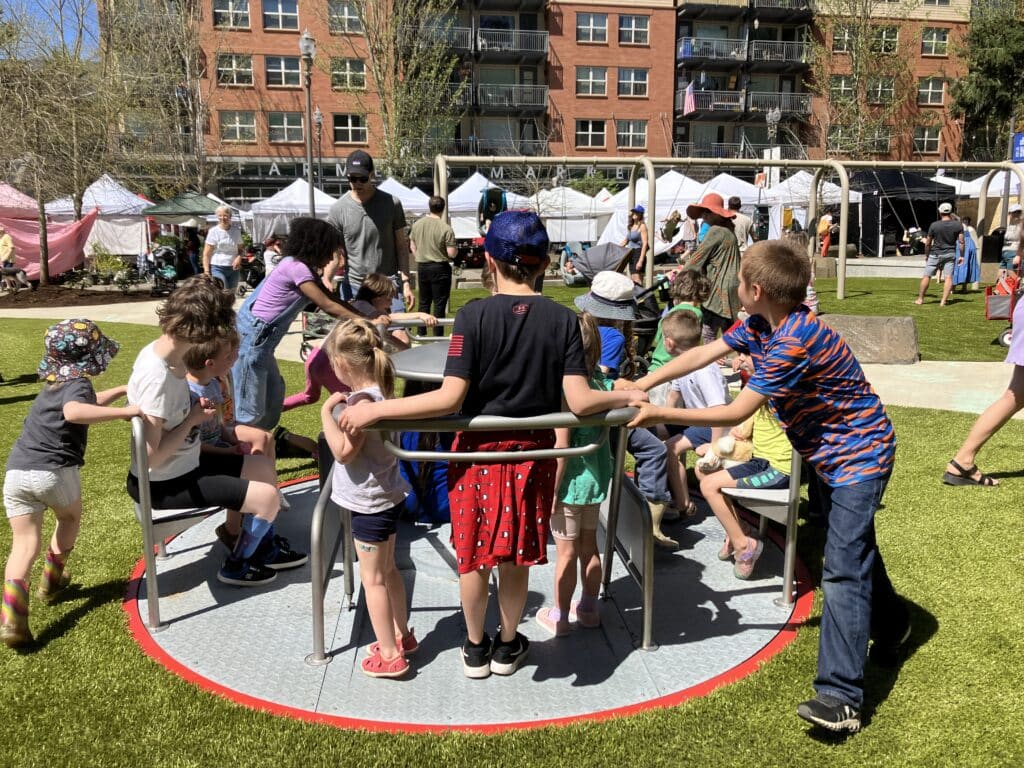
I agree with Goldberg that what makes both new playgrounds special is, “How they both fit perfectly into the parks they are in and the location of both in terms of how they are connected to other great amenities.” For example, those visiting Vancouver Farmer’s Market will surely enjoy the Esther Short playground, whether they bring kids along with them or not, as anyone who wanders over to smell the rose garden will also pass the play equipment and, as Haygood stated, “[Be] reminded of the joy I found while playing with my own children at the parks.”
But beyond equipment designed for all kinds of kids, it’s the details that encourage them to play in an inclusive way. Both at Esther Short and CHAMPS, climbing ropes are right next to the adaptive swings and the carousel is near the wide slide so kids can make connections with anyone who comes along. Even the artwork invites park-goers to reach out to others. Goldberg later told me that, “At Marshall Park, my favorite elements are the bronze art pieces by Pete Helzer, especially the turtle using a walker and the turtle using a wheelchair.”
With these two projects under his belt, Goldberg has not slowed down. The requests for his design expertise continue to come in locally and abroad. He shared with me that, “We are working on two playgrounds for the city of Bothell, Washington currently, and we are about to begin design work for a special playground project in Selma, Alabama. We have a growing backlog of people who have requested our support, so we are continuing to build tools that make it easier for people to copy our model.”
Harper’s Playground ignited a movement when Goldberg spoke at TEDx Portland in April 2014. Since that time, more cities and counties are catching on to the value of inclusive playgrounds. Though not developed by Harper’s Playground, Felida Park recently added a new play area with sensory features and accessible equipment. My kids have had soccer practice at this very busy park for years, but it wasn’t until the new area was built that I noticed children with different abilities coming out to enjoy it too.
My anecdote is just one piece of evidence that as we invest in radically inclusive playgrounds, “Vancouver residents will see themselves and one another as valued members of our community,” as Haygood hoped they would. During his speech, Goldberg also shared his dream of people feeling a desire to take care of each other while at the park. He stated, “This is now your park . . . These special features are nothing without the most important ingredient . . . The people. You all are the most important feature of this park.”
Go here and here to learn more about Harper’s Playground.
Read the Full Digital November Issue Here: