Banking Liquid Gold: Northwest Mothers Milk Bank
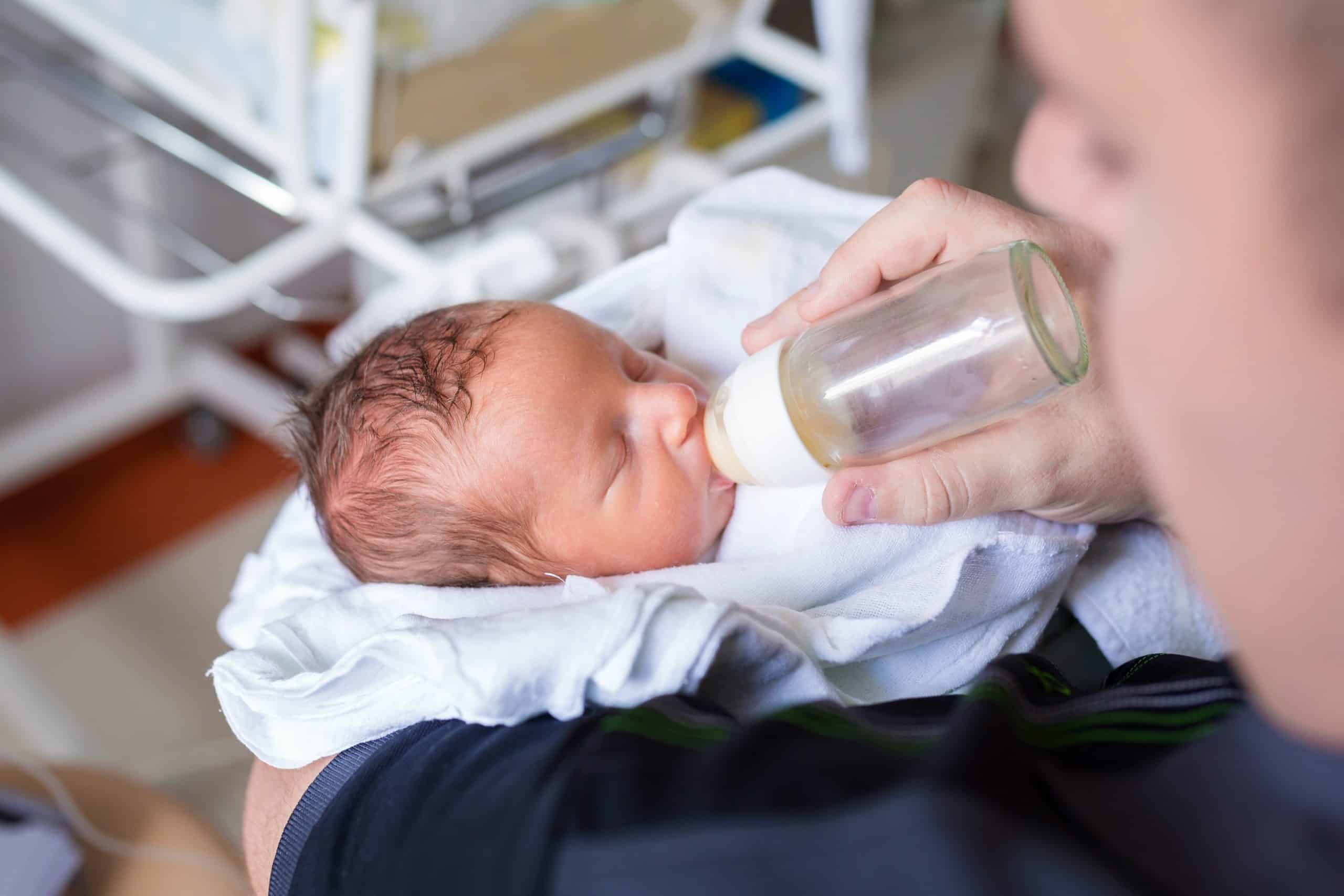
When Kimberlee Hoover’s twins were born via caesarean section at 38 weeks, she found she wasn’t producing enough milk to allow both babies to thrive. “My son had lost too much weight since birth,” Hoover recalls, “so we were told that breastfeeding in that moment wasn’t giving him the nutrition that he needed.” She assumed they would need to supplement her son’s diet with formula, until a nurse at Legacy Salmon Creek hospital, where Hoover’s twins had just been born, suggested donated breastmilk as an option, explaining the process of procuring breastmilk and how to request it. At first, Hoover didn’t know which option to choose—only that her son needed food now. “My nurse . . . brought in a warmed bottle [of donated breastmilk] to see if I would like to give it to my twins. After that, I only considered donor milk and nursing on demand/pumping while in the hospital.”
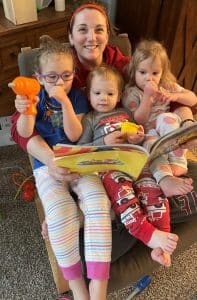
Kimberlee Hoover with her three kids, (l-r) Emilia, Wyatt, and Rylee. Photo courtesy of Kimberlee Hoover.
Donor Screening
Hoover’s experience mirrors that of hundreds of parents in the Pacific Northwest who, for a variety of reasons, are not able to breastfeed their own babies, at least for a short time, but who want or need the unique nutrients found in human milk for their babies. In times past, these types of situations would have been mediated by a wet nurse personally known to a family. But with the modern ability to crowdsource, it’s now possible to connect new parents to each other at a much larger scale. That’s where Northwest Mothers Milk Bank (NWMMB) comes in. The organization, based in Tigard, is the only nonprofit human milk bank in the Pacific Northwest, serving Oregon, Washington, Alaska and parts of Idaho. Focusing on serving medically fragile babies, including those spending time in the neonatal intensive care unit (NICU), NWMMB currently serves 78 hospitals in the region, including Legacy Salmon Creek, where Hoover’s babies were born, and PeaceHealth Southwest. NWMMB screens potential donors with a short phone interview to determine eligibility, a complete medical history questionnaire and confirmation of health history by the donor’s healthcare provider and blood work. The whole process typically takes just a few weeks. Once the potential donor “passes” these screenings, they drop off frozen milk at milk drop locations throughout the covered region (in Clark County: Legacy Salmon Creek Lactation Services and Cherish & Nurture Collective Massage Therapy). The milk is collected from these milk drop sites by NWMMB, who puts each ounce of milk through a gentle pasteurization process to ensure the safest milk possible while retaining vital nutrients, then distributes the processed milk to their partner hospitals. Top priority to receive this liquid gold are medically fragile infants. “Our primary focus is on providing milk to medically fragile populations,” says Kathryn Foubister, development coordinator for NWMMB. “One in eight infants in the Pacific Northwest is born premature. Prematurity puts an infant at risk for life-threatening infections, prolonged hospital admission, and lifelong disabilities. NWMMB prioritizes these fragile infants, providing a safe source of human milk when their mother’s own milk may not be 100% available.” Once the needs of the babies in the hospital and NICU have been met, other “outpatient” babies under age 12 months may be eligible to receive donated breastmilk, with a valid prescription and statement of medical necessity. And “in the event of a milk shortage, babies less than two months old or who have critical medical conditions will be served first,” says Foubister.
The Cost of Liquid Gold
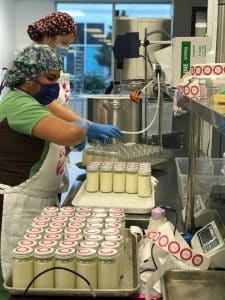
Staff members at Northwest Mothers Milk Bank’s lab in Tigard process human breastmilk to prepare it for distribution to hospitals all over the Pacific Northwest. Photo courtesy of NWMMB.
Breastmilk costs for babies in the NICU are either covered by the hospital or by the insurance company, and earlier this year, Governor Jay Inslee signed into law SB 5702, which requires insurance coverage for donor breast milk. For outpatient circumstances, “a processing fee is charged for each ounce of milk dispensed to hospitals and families in the community,” explains Foubister. “These fees allow [NWMMB] to ensure that the donated milk we receive is safe, gently pasteurized, and free of virus and bacteria. Our current processing fee is $4.50 per ounce. A lot of science, screening, and people power goes into every ounce of donated breast milk before it becomes vital nutrition for medically fragile babies. We offer financial assistance through our community care program to help cover the costs of donor human milk for families who can’t otherwise afford it.”
Moved to Help Others
All breastmilk distribution and access is based on supply and demand, which leads many breastmilk recipients, like Hoover, to eventually become donors. “I decided to donate because my own children had benefited from donation,” she says. “Had there not been donors, I would have had to explore other options for feeding my twins until my [own milk] supply was adequate. It takes a community to have children and I wanted to be a support to another family who needed it. The process of donating really brought the recipient experience full circle for our family. I was able to reflect on my own family’s experience and it gave me a sense of peace knowing that I could be helping another baby that was in the same situation as my twins.”
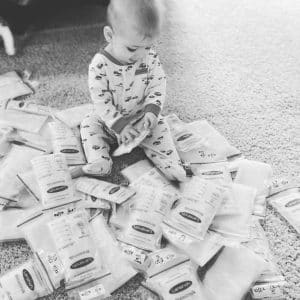
One of Christy Dunbar’s babies sits on the floor surrounded by bags of Dunbar’s frozen breastmilk ready to donate. Photo courtesy Christy Dunbar.
Christy Dunbar, a mother of three and owner of The Little Gym in east Vancouver, was never a breastmilk recipient herself, but when she found herself producing an overabundance of milk for her babies, she felt moved to help other new parents. “I was introduced to milk banking and milk donation while pregnant with my first child . . . I ran into some info about the process of donating extra milk if you met specific medical criteria, and of course I wanted to help babies in need any way that I could at a time that I felt very isolated and useless as a new mother.” After a negative pumping experience with her first child, she got a much better pump for baby number two and quickly built up a large stash of milk in her freezer. “At this point I had learned more about the process of milk donation, as several friends had NICU babies, and I felt compelled to make use of that overproduction of milk,” Dunbar says. She started setting goals for herself to donate a certain amount of milk. “The first donation was required to be a large donation of 100 ounces. Subsequent donations could be any amount of frozen milk. I donated at the Legacy Salmon Creek hospital by calling the team, who met me at the car. They took all of my milk-bricks [sealed bags, frozen flat] which were laid out . . . with the amounts labeled on them, attached the donation form, and off it went to be processed! I didn’t even have to get out of my car which was nice with three children in their car seats!” NWMMB will also send donors frozen-packing supplies to ship the milk if needed.
Why Breastmilk?
But with the development and availability of infant formula, why the need to go to all this trouble to collect and distribute human milk donations at all? “Area health care professionals and families know that human milk is proven to provide the essential nutrients and immunological protection necessary for optimal growth and improved long-term health,” says Foubister. “Promotion and support of breastfeeding is a matter of public health and is a cornerstone of the work we do.” And of course, recent infant formula recalls and shortages have brought the importance of breastmilk as a vital resource to the forefront. NWMMB did see an increase in the need for breastmilk during this crisis. “Starting in February [2022], families began to call the milk bank, sharing that their infant’s prescribed specialized formulas were unattainable,” Foubister recalls. “Babies on complicated feeding plans were being impacted more than ever. The calls began to increase significantly in May . . . In response to the growing crisis, we began working with healthcare providers to find the best solution for temporary nutritional supplementation. That work continues. Thankfully, we also saw a threefold increase in requests for donor screening and many families reached out to donate excess milk to help others.”
“I wasn’t aware of NWMMB until I needed it,” says Hoover, “but I left the experience feeling so grateful that it’s there. I’m a mom of three that has breastfed all of my babies, so I know how much work goes into breastfeeding. I think it’s an amazing act of kindness for others to donate to families that are in need.”
Learn More: