

The ERA App: Five Minutes a Day to Better Parenting
One of my clearest memories as a new parent is holding my sleeping baby on my chest while frantically Googling sleep schedules, whether or not to sleep train and how to get my child to nap without napping on top of me. I was met with thousands of search results full of contradictory information, and it didn’t stop there. I’ve been down the rabbit holes in the last ten years, searching for answers about picky eating, navigating big feelings, building confidence, difficult conversations; the list goes on. In an age where everyone has an opinion and social media is rampant, no one is agreeing and parents in search of answers are exhausted.
Joshua Iwata, the CEO of Parent Lab and one of the creators of the ERA parenting app, aims to address this problem. “It’s clear that we have more resources than ever, but parents are still saying that parenting is harder than it was 20 years ago,” he says. Portland-based Parent Lab has been developing a way to streamline answers that are specific to parents’ individual needs. The ERA app, which launched in January of this year, is using AI guidance to help parents learn, reflect and create meaningful bonds with their children.
Iwata was born and raised in Vancouver, moved overseas to India for a time, and now resides back in Vancouver, where his two kids attend Vancouver School of Arts and Academics. He has held numerous roles within the tech industry, ranging from web design, product design, COO and CEO, in addition to his work as an artist, but still maintains that parenting has been his longest, hardest and most important job. After so much time in the industry, Iwata came to a realization: “We are in a place that is using so much time and so many people’s talent and money on food delivery and whatever the next dating app is, but not committing resources to parenting.” He says this is what put the creation of the ERA app in motion—a desire to narrow the vast shield of information and use technology to personalize and simplify parenting guidance.
Curated, Personal Guidance for Parents
The conceptualization of the ERA app began about five years ago, with the Parent Lab team diving deep into research and development. They spent this time interviewing experts, creating content and brainstorming the most effective and efficient way to help parents connect with their children and feel confident in their choices. But with the multitude of parenting approaches and methods out there, what kind of framework would ERA app choose?
“The very big picture we are trying to create is generational wellness for families,” says Iwata, explaining that the best way to achieve this is by “creating a compass that always points toward secure attachment.” Secure attachment is a term psychologists use for when a young child feels confident and supported by their caregiver. Insecure and avoidant attachments occur when there are inconsistent responses from caregivers leading a child to feel confused and distrustful. If a secure attachment is formed in childhood, it will have a lifelong impact on future relationships.
Iwata speaks passionately about attachment theory and cites psychologists who believe that a meaningful connection and attachment might just be the most important thing we can give to a child. With that type of connection, children are more apt to go off and explore, be independent, regulate their emotions, problem solve and be truly trusting and empathetic. The app can be used for children of any age, but Iwata says the best time frame to use the ERA app and work on this strong connection is for children up to 12 years old.
With that in mind, the ERA app aims to help curate personalized guidance for parents. The app is designed to be used daily or several times throughout the week to reflect on parenting and provide personalized guidance. Because a child’s development is rapidly changing, the guidance on ERA will change as well. “We want a product that grows with you,” says Iwata, “and we also want a personalization that’s so unique that 1,000 parents could experience one piece of content in 1,000 different ways.”
Reflection and Mindfulness
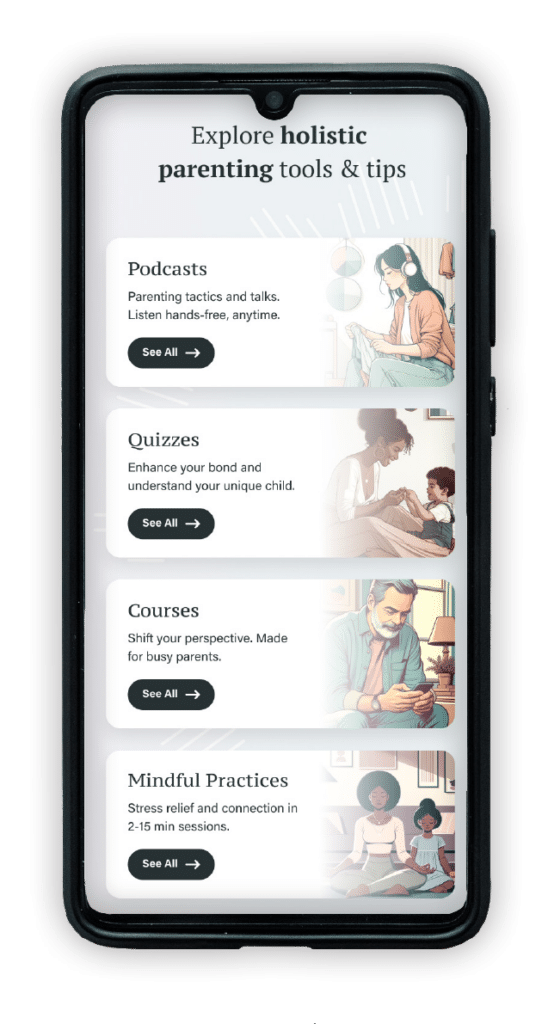
ERA is multi-faceted and aims to improve parent-child connection through reflection, mindfulness practices and tailored information. To know you and your children better, there are quizzes to identify your child’s habits and temperaments, and then there are daily check-ins and reflections that take an average of about five minutes to complete. After using the app for several days, the check-ins become more specific and tailored to your child and include follow up on prior reflections. Essentially what ERA aims to do, is to take the sometimes-overwhelming umbrella of parenting and narrow the scope into manageable chunks.
After checking in, ERA is getting more acquainted with our parenting styles and our kids’ behaviors. Each check-in is usually followed up with a tidbit of child development, neuroscience, a helpful suggestion, or just validation that we as parents aren’t irrevocably messing up our children. And while the bulk of the app is geared towards our parenting practices, Iwata also says the app acts as a bit of a Trojan Horse and ushers in some much-needed mindfulness and grounding opportunities for busy, stressed-out parents.
If the goal is for our children to feel independent and safe while still connected to us, then how we take care of ourselves is equally important. Iwata says, “For a parent to be a guide, your child needs to see you as stronger, wiser, centered and kind.” To support that, the app offers bite-sized meditation and mindfulness practices because just the small act of reflection and stillness can make an enormous impact.
Rooted in the Science of Child Development
One of the goals of ERA is to bring relevant and specific information to help support your goals. Not only will check-ins be a conversation specific to your child, but your personalized library based on your responses will start to gather podcasts, articles and mini courses related to whatever needs arise. While the app launched in January, creators say the technology is still developing and features are being refined as they work towards their ambitious goals.
Former content director for the ERA app, Jennifer Maerz, says the goal of ERA is to cut down on the overwhelm and provide parents one source that’s rooted in science, mindfulness and child development. “We want to close the gap between learning something and that middle-of-the-night or post-meltdown question about how to apply this information to my child,” she says. As a mother of a 6-year-old, Maerz uses the app in her personal life as well and says it’s been immensely helpful when it comes to her daughter’s picky eating. After hitting another wall at dinner time, ERA provided specific suggestions about incorporating her daughter into meal planning and making planning more playful and fun. “Even though I’d heard these suggestions before, it gave me one thing to think about and try,” says Maerz, who had success by taking her daughter’s love of gardening and incorporating that into meal planning. “I’m not going to change my daughter,” she says, “but I can change my mindset.”
When asked about any concerns of using artificial intelligence in the app, Iwata says privacy on the database is of utmost importance. “Surprisingly, in our research,” he says, “we thought parents might be kind of freaked out by the idea of an AI that gets to know you, but we haven’t found that to be the case, meaning there’s already kind of a comfortability with AI.” As AI continues to be a growing feature in everyday lives, we may as well harness it and use it to our advantage.
How It Works
I was given the opportunity to spend several weeks exploring the ERA app to better understand it and try it out in my own family. My children, (who conveniently forgot to bring their manuals with them at birth) and I have simultaneously looked forward to each new stage of their development while also struggling with the new sets of challenges they bring. My children are also wildly different and what works with one will almost certainly backfire with the other. My daughter recently turned 10 years old and this year we’ve been grappling with all sorts of new issues: navigating difficult friendships, responsibility, anxiety and screen time. With my son, age 7, we are in different territory dealing with picky eating, processing difficult emotions and learning to lose without tanking the rest of the evening for those around him. I am constantly wondering if I’m doing any of this right.
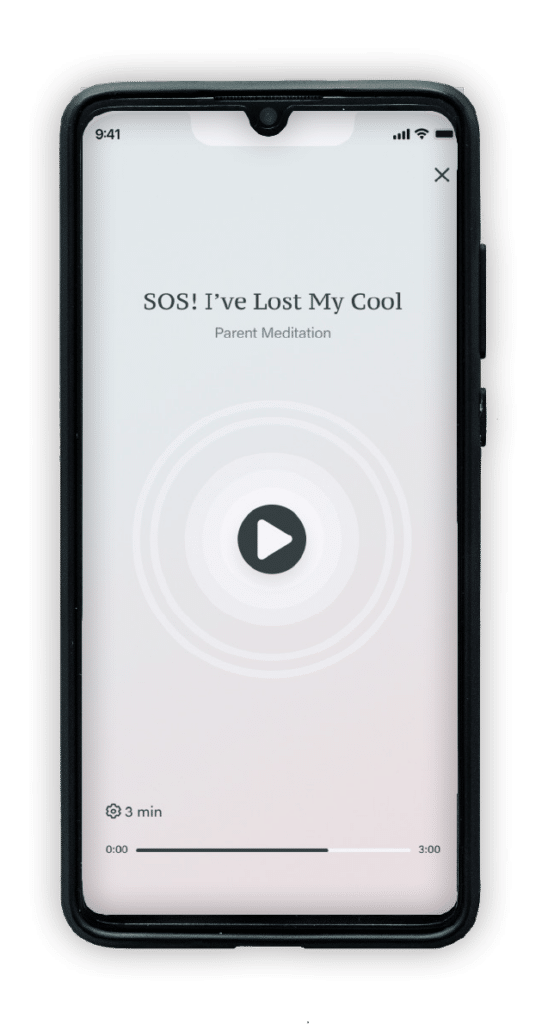
I have never been tech savvy, but I was determined to keep an open mind as I downloaded the ERA app. Luckily for me, it’s quite user friendly. The very first day, I took several quizzes about both of my children, noted a few specific issues I wanted to work on and did a 3-minute meditation about staying grounded. I’m a big fan of small, manageable practices. For the past several weeks, I’ve been frequently using the app right after the kids go to bed and I’ve had quite a few observations.
First, ERA helps me to home in on a particular focus. As someone with anxiety, I tend to worry about anything and everything, and the chance to think about what an issue is right nowhelped me to narrow the scope. Maybe not every problem demands immediate attention! Second, I recognized that there are some things I’m doing well, and as a parent, sometimes you just need to hear that. The chance to reflect on small victories was a pleasant reminder that I did handle that meltdown well yesterday and sometimes I’m doing a better job than I give myself credit for.
The app also gave me some reminders about what is developmentally appropriate for my kids’ ages. (Spoiler alert: lots of kids this age struggle with losing.) It’s also a reminder that big feelings and struggles are not only developmentally appropriate, but necessary for kids to get comfortable with struggle and problem solving. I got a few tricks and techniques that were helpful when we played a family game of Mario Kart and encountered the next inevitable struggle with defeat.
Perhaps my biggest takeaway from the reflections was thinking about how I was showing up during these episodes. Was I calm? Was I able to maintain my composure to support their emotional regulations? And the chance to think about that made me recognize that while sometimes I am, there’s work to be done in order for me to keep my cool.
I’ve started using more of the calming meditation practices, and usually only a few minutes at a time, as a touchstone to come back to and remind myself of how I would like to show up. I also shared the app with my husband because oftentimes, the mental load of parenting can fall on mothers. He said, “I’m really used to focusing on the nuts and bolts of parenting and I tend to only address problems as they arise.” He went on to say, “I liked that the app had me thinking about challenges from a sane, calm place and be more proactive rather than reactive.” As we reflected individually, it also gave us the opportunity to connect and chat about what we were doing well as parents, and which areas deserved more intentionality and focus.
Generational Wellness for Families
While the creators at Parent Lab are working hard to hone the technology and offer continual improvements, there’s much to be gained right now from the ERA app. In a world with more information available than ever, parents deserve focused information that allows them to reflect and be intentional about creating strong connections. “Most people are familiar with generational trauma, but not generational wellness,” says Iwata. “We want to perpetuate a cycle of change that brings wellness into a family.” There are numerous ways, of course, to do this, but ERA can be one avenue to help achieve that path. Iwata and the Parent Lab team are hopeful that they’ve created something that will do just that. He says, “Spend five minutes a day thinking and reflecting about your parenting, and I think it will change your life.”
Read the Full June 2024 issue here:
Go here to download the ERA app (currently available only in the App Store for Apple devices).
Go here for more posts on parenting.