



Sky High: Youth Aviation Programs Prepare Kids to Soar
In the past few years, a pilot shortage has drastically impacted the aviation and travel industry. Bob Martilla, a local pilot and member of Experimental Aviation Association (EAA), says, “We are running out of people in aviation: mechanics, technicians, pilots, engineers.” He continues, “The whole aviation business is in the same flux that the rest of the economy is, but in aviation that is a critical problem. Unless we introduce youth to aviation one-on-one this can’t be turned around.”
With an intense demand for pilots and aviation professionals, the need for young people interested in the field is greater than ever. The rigorous and financial demands of flying, however, can create an immense hurdle, and many young prospective pilots don’t know where to start. Thankfully, Southwest Washington is rich with local programs and resources to send them on their way.
From Ground School to Earning Wings
For Juliette D., 2024 is the year she graduated from Washougal High School and earned her private pilot’s license. “My dad has his pilot’s license and has always loved aviation, so I’ve grown up around it,” she says. When Cascadia Tech Academy presented their various opportunities at her high school and she learned about their aviation program, her interest was piqued. She was questioning the logistics of making it work when her best friend stepped in and said, “I can tell you want to do this. You should figure it out.”
Cascadia Tech offers tuition-free career and technical education in 18 program areas to juniors and seniors in Southwest Washington. The Aviation Science and Technology program accepts 120 first-year students and 40 of the highest performing students can return for a second year. Instructor Kim O’Neal says, “I would keep them all if I could!” Students are admitted via their sending school based upon slots that are allocated to member school districts. Instructor Rob Reinebach shares, “We aim to be the premier pathway into the aviation industry for our students. Our goal is to ensure that every eligible student with a passion for airplanes knows that we are a great option for them.”
Aviation students’ days typically consist of time in the classroom, using high tech simulators, team building, learning the mechanics and physics of airplanes and getting a solid foundation in aviation groundwork. “Our golden bucket list item is to add flying to the program,” says O’Neal. Students complete pilot ground school training and are eligible to take the written portion of their private pilot exam.
For Juliette, her time in Cascadia Tech saved her money for pilot ground school and provided networking opportunities and connections. She ended up earning $8,000 in scholarships which she used toward her flight training through FLYIT Academy in Camas. After her first discovery flight in June of 2023, she said, “I loved it and just wanted to keep doing it as much as possible.” In September of this year, she earned her private pilot’s license at age 17.
Juliette is now attending Green River Community College in Auburn, working toward her Bachelor’s of Aeronautical Science and plans on becoming an airline pilot. One of the major perks of completing two years of Cascadia Tech, says O’Neal, is the transferrable credits to Green River and walking out of high school with a nearly finished AA degree.
A Supportive and Transformative Aviation Community
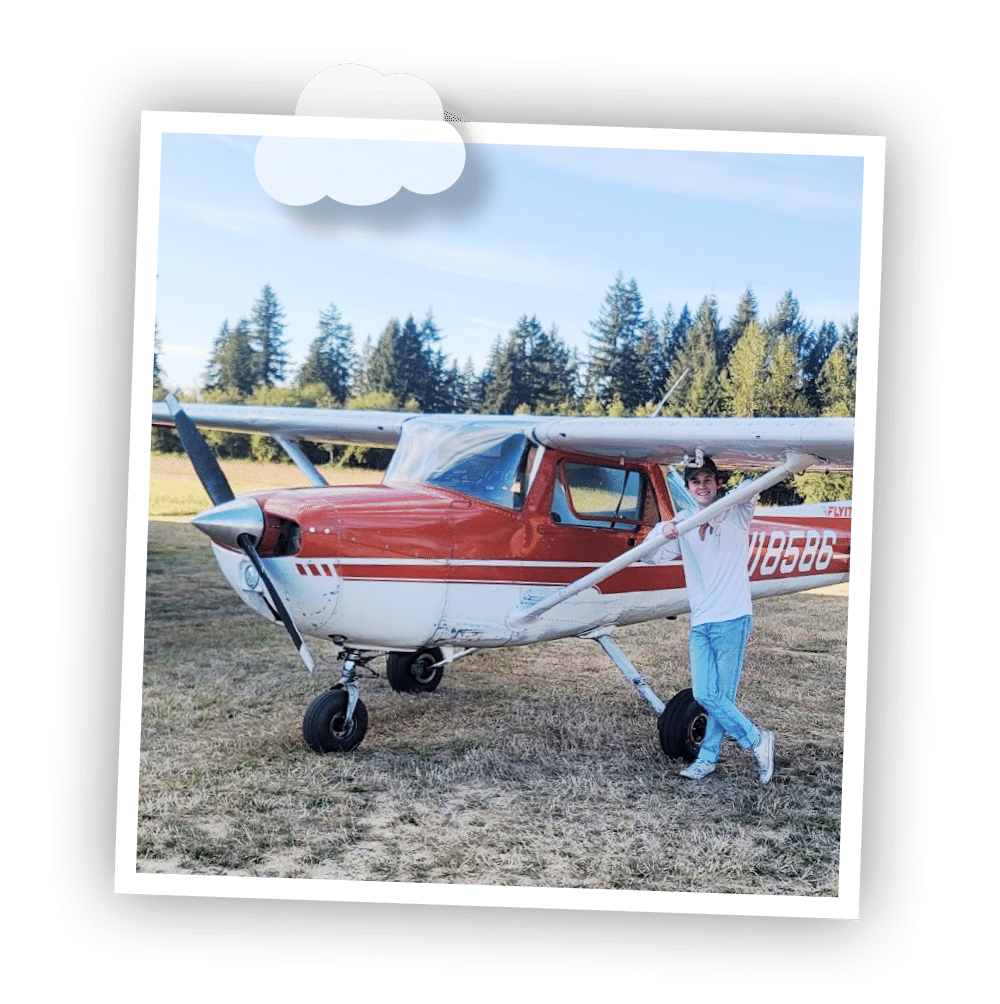
Alex Cazel, a second-year student in Cascadia, has nothing but positive things to say about Cascadia’s program and the aviation community in general. “People in this community want to help and support you,” he says. During his second year, Cazel is tasked with leadership responsibilities and helping the program run smoothly for first year students while he works toward his own dream of becoming a bushcraft pilot in Alaska. Cazel has flown a plane several times through FLYIT, but says the money ran out so he’s busy applying for scholarships. He’s now debating whether to use any funds for flight school or to finish the partially built plane in his garage.
Of his first few flights with an instructor at FLYIT, Cazel says, “You don’t realize how much you’ve learned until you’re up in the plane and realize you actually know a lot.” In Southwest Washington, two of the main flight schools are Aero Maintenance Flight School at Pearson Airfield and the aforementioned FLYIT Academy at Grove Field in Camas.
Jason Nemeroff, an instructor with FLYIT Academy, sees students from all walks of life, ages 11 through 80 years old. For anyone wanting their pilot’s license, the minimum requirement of time in an airplane is 40 hours, but he says the national average is closer to75 hours. “Our priority is not to prepare someone to take the test, but to become as safe a pilot as possible in as much time as it takes,” says Nemeroff. If students haven’t had the advantage of going through a program like Cascadia Tech, they will do lots of groundwork preparation, studying and flying alongside an instructor until they’re prepared to fly solo.
The time and finances of becoming a pilot are intense, and one FLYIT student advises not to rush: “You’re here to have fun. Enjoy the stage you’re at.” For Nemeroff, the experience of flying and instructing sometimes feels too good to be true. “I’m so lucky I almost don’t even want to talk about it,” he says. “My main passions are airplanes and helping people, and that’s my day job.”
Every pilot I interviewed spoke to the transformative powers of learning to fly. “You can’t be a victim when you’re flying an airplane,” says Nemeroff. “There’s no one to blame, no one to do it for you—you’re learning accountability and responsibility, and it changes the way you see life.”
Martilla adds, “I’ve seen a few kids without direction or a purpose and after they start helping out with airplanes, pretty soon they’re learning to be mechanics and then they’re wanting to learn to fly. But they have to be exposed to it first and that is what Cascadia, flight schools and EAA do.”
Even beyond flight schools and programs like Cascadia Tech, there are organizations committed to engaging young potential pilots. EEA Young Eagles is a group of volunteer pilots who take kids ages 9 to 17 years old on discovery flights each month to introduce them to possibilities in aviation. If old and mature enough, some of these kids will get to experience flying the plane themselves, under the direction of the pilot in command.
From May to September, these pilots fly up to 20 kids out of Pearson Field at no cost to the families, on a first-come, first-served basis. Martilla, a Young Eagles coordinator, says, “You won’t believe how happy these kids are after they’ve been in a plane, and it’s such a positive experience for parents too.”
Exploring Opportunities in Aviation
The Vancouver area is rich with resources for prospective pilots or young people who are curious. Local chapters of groups like Women in Aviation and the Ninety-Nines empower prospective female pilots through events like Girls in Aviation Day. Camas Washougal Aviation Association (CWAA) hosts summer programs for middle school students to build and fly planes. The education center at Pearson Field hosts Airway Science for Kids (ASK) for children of all ages to play and learn about science, technology, engineering, math and aviation. All of these programs are committed to the goal of exposing young people to the endless possibilities related to flight.
Stefan Kulpa, a pilot with Aero Air in Hillsboro, transports medical teams and human organs to different hospitals across the country for life saving operations. He says, “It wasn’t until I got into aviation training that I realized how many avenues are available.” Kulpa adds, “I know pilots who started in the military, pilots who started on the civilian side, pilots who fly seaplanes over water and rarely climb over 1,000 feet, and pilots who fly 747s around the world.”
Beyond flying, any passion for airplanes can lead to careers in airport management, air traffic control, mechanics, engineering, instructing and just about anything your imagination can come up with. “Your goals might change throughout your training as you become more aware of the opportunities out there,” Kulpa says.
The hard part, most pilots admit, is the cost. High expenses are, unfortunately, the nature of the beast. But local groups are determined to make it more accessible by offering scholarships. CWAA gave away ten scholarships last year totaling $35,000. O’Neal says a large priority for Cascadia Tech is finding scholarship opportunities for continuing education and flight hours. This program helps students network with professionals in this career field. They are always looking for people to join their advisory board to help shape the direction of the program and support students.
If the passion and the persistence are there, most pilots insist that it’s doable. Juliette D. advises anyone who is interested to go after it: “Be proactive and persistent—do your research, find the flight schools in your area and find people you can talk to. If you have the motivation, you can do it.”
Read the full November 2024 issue here:



Andy Woodrow
Emily…great article and very timely. The AFJROTC programs at Battle Ground and Prairie High Schools also line students up for pilot training. Battle Ground has sent 12 students to earn their pilots licenses over the last 5-years; all go to a university based program (e.g. Purdue, Embry-Riddle, University of Maryland) for an 8-week training program that results in pilot certification.
Nikki Klock
This is fantastic, Andy, thanks for sharing!